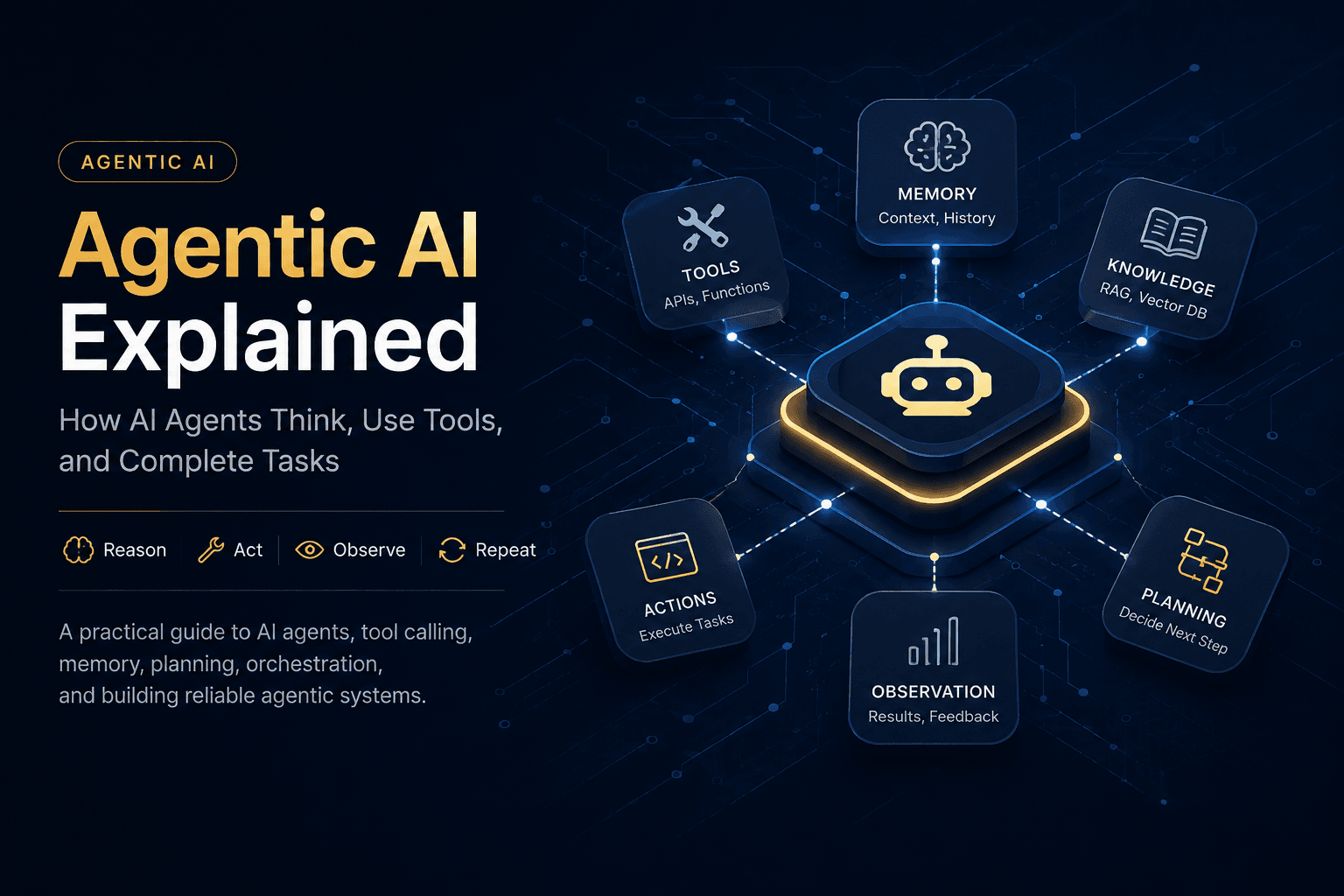
Agentic AI: From Chatbots to Systems That Can Act
A practical introduction to Agentic AI, exploring how AI systems move beyond generating responses to reasoning, using tools, maintaining context, and completing multi-step tasks.
 AI & ML / field notes
Agentic AI: From LLMs to Systems That Can Act
Large language models changed the way we interact with software.
Instead of navigating through menus, learning complicated interfaces, or writing precise commands, we can now describe what we want in natural language.
Ask a model to explain a concept, write code, summarize a document, or brainstorm an idea, and it can produce an answer almost instantly.
But there is a fundamental limitation.
A model that can generate an excellent answer is not necessarily a system that can complete a real-world task.
Consider the difference between these two requests:
and:
The first problem can be handled reasonably well by a single model call.
The second requires a workflow.
The system may need to:
- Understand the objective.
- Break the objective into smaller tasks.
- Search for information.
- Retrieve relevant documents.
- Call external tools.
- Analyze the results.
- Decide what to do next.
- Recover if something fails.
- Produce the final result.
This is where Agentic AI becomes interesting.
Agentic AI is not simply "a smarter chatbot."
It is an approach to building AI-powered systems where a model participates in a controlled loop of reasoning, decision-making, tool usage, observation, and action.
1. From Chatbots to Agents
Let's start with a traditional LLM application.
The architecture is simple:
User
  │
  ▼
Prompt
  │
  ▼
Large Language Model
  │
  ▼
Response